

Twenty-two percent of healthcare leaders say their organization loses at least $500,000 a year to denied claims. Providers spend close to $20 billion annually just reworking the ones that come back. If any of that sounds familiar, you already understand why this topic gets so much attention in healthcare finance right now.
Revenue cycle management, or RCM, is the process that connects everything between a patient booking an appointment and the practice actually getting paid for that visit. Done well, it’s invisible. Done poorly, it shows up as slow cash flow, mounting denials, and a billing team spending more time chasing payments than anyone would like.
This guide walks through what healthcare revenue cycle management actually covers, how the process works step by step, where most practices lose money, and what to look for if you’re considering outsourcing it.
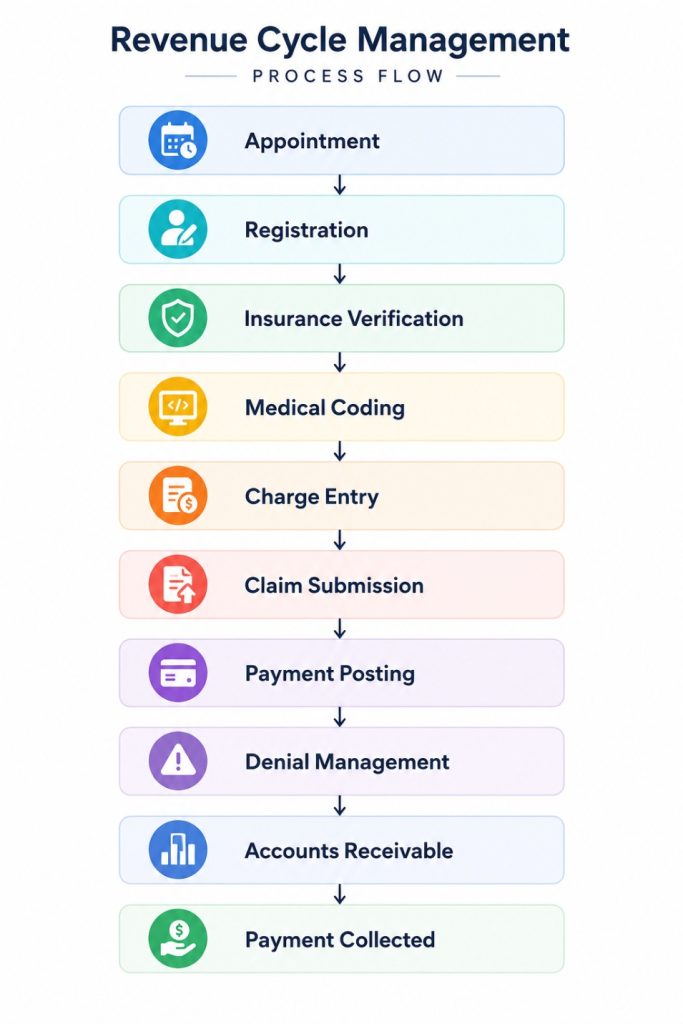
The Healthcare Financial Management Association defines it as all the administrative and clinical functions that go into capturing, managing, and collecting patient service revenue. That’s a mouthful, but the idea underneath it is simple: RCM is everything that happens financially between a patient scheduling care and the provider getting paid in full for it. Some people call it RCM healthcare or just RCM for short, but it’s the same function either way.
People often use “medical billing” and “revenue cycle management” as if they mean the same thing. They don’t. Billing is one piece, the part where a claim actually goes out to a payer. RCM includes that, plus everything before it (registration, insurance verification, prior authorization) and everything after it (payment posting, denial management, accounts receivable follow-up, patient collections).
Most healthcare organizations break the revenue cycle into three phases:
Miss a step in any one of these phases and the effect shows up downstream, usually as a denied claim or a slower payment, not as an obvious failure at the point where it actually happened. The stakes for getting this right keep climbing too: Experian Health’s 2025 State of Claims report found 41% of providers now say at least one in ten of their claims gets denied, up from roughly 30% just three years earlier.
The medical billing RCM cycle breaks down into three stages, and each one has its own way of quietly costing a practice money if it’s mishandled.
The revenue cycle doesn’t start when a claim goes out. It starts the moment a patient calls to book an appointment. Front-end staff collect demographic information, verify insurance coverage, and confirm what the patient will owe out of pocket.
This stage catches problems before they get expensive. A single wrong digit in a policy number, or a lapsed plan nobody flagged, turns into a denied claim weeks later. That’s why insurance verification exists as its own specialty inside RCM rather than something a front-desk employee squeezes in between phone calls. It’s a bigger factor than most practices assume: half of the revenue cycle leaders surveyed in Experian Health’s 2025 report named missing or inaccurate patient data as the single biggest driver of denials, ahead of coding or authorization issues.
Once the visit happens, clinical documentation has to become a set of billable codes. Certified coders translate what the provider did into ICD-10 diagnosis codes and CPT or HCPCS procedure codes, and charge entry staff apply the correct fee schedule on top of that.
Coding errors are one of the top reasons claims come back unpaid. A missed modifier or an outdated code can turn a clean encounter into a rejected claim, which is why practices increasingly hand this off to dedicated medical coding teams instead of asking clinical staff to code their own visits between patients. Regular medical coding auditing, spot-checking a sample of claims before they go out, catches the kind of drift that would otherwise show up weeks later as a pattern of denials.
The back end is where the money actually moves. Claims go out electronically to the payer, payments get posted against the patient account, and anything left unpaid moves into follow-up.
This is also where most of the RCM workforce spends its time, because a claim rarely just gets paid and closed. Someone has to track down partial payments, resubmit rejected claims, and chase the accounts sliding past 30, 60, and 90 days outstanding. Practices that don’t actively manage accounts receivable tend to watch their average days in AR creep upward every quarter, which is a slow, quiet way to lose revenue that never shows up as one dramatic event. The standard accounts receivable days formula is total outstanding AR divided by average daily charges, and tracking that number monthly, not quarterly, is usually the difference between catching a problem early and finding out about it too late.
Some accounts age out past the point of a normal appeal, and treating them as a lost cause is usually premature. A dedicated write-off recovery process can still collect on claims that have already been written off internally, which is worth checking before anyone closes the book on them for good.
If there’s one part of the revenue cycle that deserves more attention than it gets, it’s denials. According to HFMA, the average cost to rework a single denied Medicare Advantage claim is now $47.77, and $63.76 for a commercial claim. Multiply that across the roughly three billion claims submitted industry-wide each year, and the administrative cost of denials alone approaches $20 billion.
It gets worse from there. Separate industry benchmarking from Kodiak Solutions puts the average initial denial rate industry-wide at somewhere around 11 to 12%. For a practice billing 300 claims a month, that’s more than 30 denials every single month, each one needing to be investigated, corrected, and resubmitted before the payer’s filing deadline closes the door on it permanently.
A good denial management services provider isn’t just about appealing claims after they bounce. It means tracking denial reasons back to their root cause, whether that’s a coding gap, an eligibility issue, or a documentation problem, and fixing the process upstream so the same denial doesn’t happen again next month.
Worth knowing the difference between two codes that get lumped together but aren’t the same thing. A CO-45 denial code just means the billed charge was higher than the payer’s contracted rate, a routine contractual write-off, not something to appeal. A timely filing denial code is the opposite: fully preventable, and if a claim genuinely qualified for payment but missed the payer’s submission deadline, that revenue is usually gone for good. Knowing which one you’re looking at determines whether it’s worth spending staff time on.
Every healthcare organization eventually asks the same question: build an in-house billing team, or outsource revenue cycle management to a specialist partner? It isn’t all-or-nothing either, plenty of practices keep some functions in-house and hand off the rest.
In-house teams offer direct control and familiarity with your specific patients and payers. But they also mean carrying the full cost of salaries, training, billing software, and compliance updates, and absorbing the hit when an experienced biller leaves and takes months of institutional knowledge with them. Staffing turnover is one of the more common reasons practices see their denial rates climb in the first place, and it’s not a minor risk: front-office and billing turnover in healthcare runs as high as 40% in some workforce surveys, well above the national average across other industries. That’s exactly why revenue cycle management staffing has become its own specialized hiring problem rather than something a general office manager can solve on the side.
Outsourcing shifts that cost and risk to a team that specializes in nothing but RCM. In effect, you’re trading a patchwork of in-house effort for a dedicated healthcare revenue cycle management solution. A good outsourced partner brings certified coders, dedicated AR follow-up staff, and experience across dozens of payers and specialties, often at a lower total cost than maintaining an equivalent in-house team. It also typically covers provider credentialing services, the time-consuming process of getting providers approved with Medicare, Medicaid, and commercial payers. It’s the same function people mean when they search for doctor credentialing services or credentialing companies, and one that stalls billing entirely if it’s mishandled.
Neither model is universally right. A large health system with a mature internal team may only need to outsource denial management or credentialing. A smaller practice growing faster than its administrative staff can handle is often better served handing off the entire revenue cycle. Here’s how the two approaches actually compare: