
Quick Answer: How Do You Know It’s Time to Outsource?
The most common medical billing errors that delay reimbursement are, in roughly the order they show up: incomplete patient registration data, eligibility gaps, missing prior authorization, wrong or outdated codes, upcoding or unbundling, missing modifiers, duplicate claims, thin documentation for medical necessity, coordination-of-benefits mistakes, and missed timely filing deadlines. Every one of them is preventable before a claim ever leaves your building.
Most denied claims were never actually complicated. They were wrong in one small, fixable way before they ever left the building, a transposed digit in a member ID, a modifier nobody double-checked, an eligibility screen nobody re-ran. Fix that one thing before submission and the claim goes through clean. Miss it and the claim comes back weeks later, and now it’s a resubmission, a phone call to the payer, and a line item on next month’s aging report.
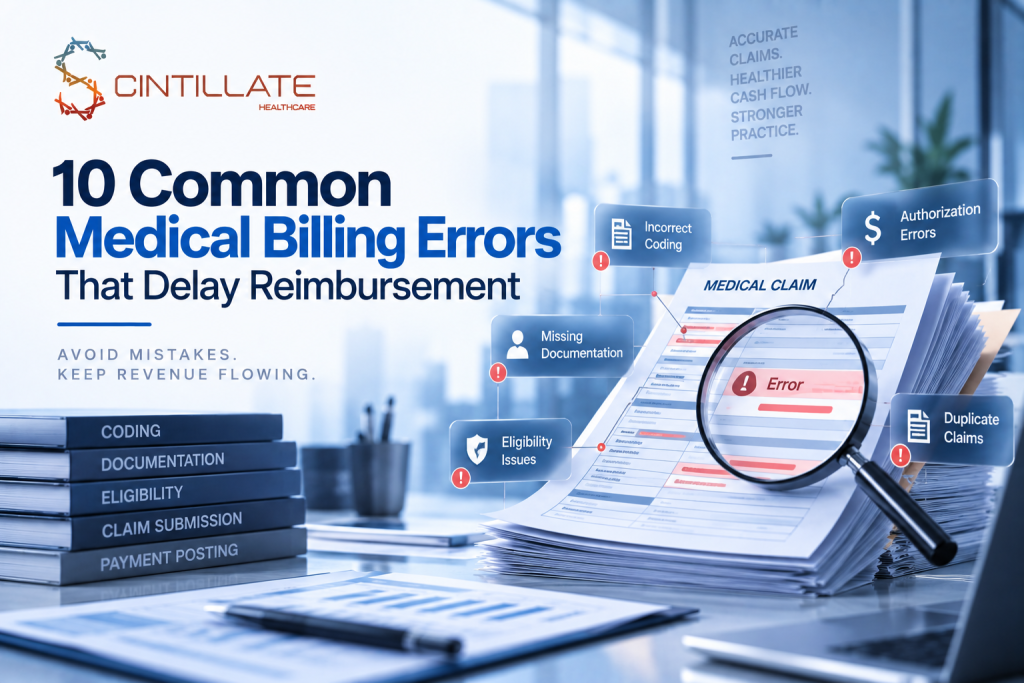
Medical billing errors are the actual mechanics behind the denial and delay numbers every RCM report talks about. Below are the 10 that show up most often across practices of every size, why each one keeps happening even at organized offices, and what actually catches it before a claim goes out the door.
| Error | Why It Happens | Fastest Fix |
|---|---|---|
| Registration errors | Front desk keys in a typo'd DOB, ID number, or insurance detail during a rushed check-in | Real-time eligibility and demographic verification at check-in, not a batch review after the fact |
| Eligibility not verified | Coverage is assumed to still be active because it was active last visit | Re-verify eligibility at every visit, not just new patients |
| Missing prior authorization | Payer added the CPT code to its auth list and nobody updated the checklist | A centralized, payer-specific prior auth list reviewed monthly |
| Wrong or outdated codes | ICD-10/CPT updates land mid-year and old code sets stay in the EHR template | Coding staff cross-check current-year code sets before submission, not after a denial |
| Upcoding, undercoding, unbundling | Coder guesses at specificity instead of confirming it against documentation | Pre-submission coding review against the actual clinical note |
| Missing or wrong modifiers | Modifier 25 or 59 gets dropped, or applied to a code it doesn't belong on | A modifier-specific edit check built into claim scrubbing |
| Duplicate claims | A claim gets resubmitted before the first one has actually adjudicated | Track claim status before resubmitting, not on a fixed calendar cycle |
| Thin documentation | Clinical note doesn't spell out why the service was medically necessary | Documentation checkpoints built into charting, not caught after denial |
| Coordination of benefits errors | Patient has two payers and the wrong one gets billed as primary | Ask about other coverage at every registration, not just intake |
| Missed timely filing deadlines | A claim sits in a backlog until it's past the payer's filing window | Age claims by deadline risk, not just dollar value |
This is the one everything else sits on top of. A patient’s insurance ID gets keyed in one digit off, a name doesn’t match the payer’s file exactly, a date of birth is transposed, and none of it looks wrong on the screen at check-in. It only shows up when the payer’s system tries to match the claim to a member record and can’t.
It’s also, by a wide margin, the biggest single driver of the problem. In Experian Health’s 2025 State of Claims survey, 50% of revenue cycle leaders named missing or inaccurate claims data as the top factor behind rising denial rates, up from 46% the year before, and more than a quarter said at least 10% of their denials trace directly back to errors made at intake.
Front desk staff are usually rushing a full waiting room, not being careless. The fix isn’t a stricter policy memo, it’s catching the mismatch at the point of entry with real-time verification, before the data ever makes it onto a claim.
A patient’s coverage was active the last time they came in, so nobody re-checks it this time. Except plans change mid-year more than most practices assume: an employer switches carriers, a patient ages onto Medicare, a secondary plan gets added or dropped. None of that shows up unless eligibility gets re-verified at every single visit, not just for new patients.
The gap between “checked once” and “checked every time” is exactly where a clean-looking claim turns into a coverage-not-active denial, four weeks after the visit, for a reason nobody remembers by the time it lands on someone’s desk.
Prior authorization lists don’t stay still. A payer adds a CPT code to its auth requirements mid-year, or an authorization that was approved for six visits quietly runs out on visit five, and the claim for visit six goes out exactly like the first five did. It comes back denied, and now the service already happened with no way to retroactively secure the authorization that would have gotten it paid.
This one carries a real operational cost even when it’s caught. Prior authorization remains one of the top reported denial triggers, cited by 35% of revenue cycle leaders in Experian Health’s 2025 survey, and a 2024 AMA physician survey found that physicians and their staff spend an average of 13 hours a week on prior auth work, with nearly 90% reporting it contributes to staff burnout. Keeping a live, payer-specific authorization list, reviewed monthly rather than reactively after a denial, is the only real fix.
ICD-10 and CPT code sets update every year, sometimes mid-year for specific specialties, and a code that was correct in January can be retired or replaced by October. Medical coding errors like this rarely feel like errors at the time. The code exists, it’s close enough to what happened, and the claim goes out looking clean.
CMS’s own numbers make the scale of this clear. HHS reported $28.8 billion in Medicare fee-for-service improper payments in 2025, and of the identified root causes, incorrect coding accounted for 10.8% on its own, with insufficient documentation, a closely related problem covered below, responsible for over half. A coding team that cross-checks current-year code sets before submission, rather than relying on whatever’s saved in the EHR template, catches most of this before it ever reaches a payer.
These three sit in a different category from a simple typo, because they change what the practice is actually claiming happened. Upcoding bills a higher-complexity code than the documentation supports. Undercoding does the opposite, quietly leaving revenue on the table out of caution. Unbundling splits a single billable procedure into separate line items that should have been reported together under one comprehensive code.
Whether any of these is intentional almost doesn’t matter to a payer running an audit. A coder guessing at specificity instead of confirming it directly against the clinical note is how most of this happens, not fraud, just a shortcut under time pressure. The fix is the same either way: a pre-submission review that checks the code against the note, not against habit.
Modifiers carry more weight than their two characters suggest. Modifier 25 tells a payer a separately identifiable E/M service happened on the same day as a procedure. Modifier 59 says two procedures that might otherwise look bundled were actually distinct. Drop either one, or apply it to a code it doesn’t belong on, and the claim either gets bundled incorrectly or denied for lacking the documentation to support it.
This is exactly the kind of error that’s invisible to a biller scanning a claim quickly and obvious to a payer’s automated edit engine instantly. Building a modifier-specific check into claim scrubbing, one that flags a missing or questionable modifier before submission instead of after a denial code comes back, closes most of this gap on its own.
A claim goes out, nobody hears back within the practice’s usual turnaround window, and it gets resubmitted just to be safe. Except the first one was still processing, and now the payer’s system sees two claims for the same service and flags the second one as a duplicate, sometimes denying both while it sorts out which is legitimate.
This one is almost entirely a tracking problem. A practice that checks claim status before resubmitting, instead of resubmitting on a fixed calendar rule like “if I haven’t heard back in two weeks,” avoids creating a second, self-inflicted delay on top of whatever caused the first one.
The service was medically necessary. The clinical note just doesn’t say so clearly enough for a payer reviewer who wasn’t in the room to agree. This is a subtler failure than a wrong code, because the claim can be technically accurate and still get denied for lacking the documentation to justify it.
It’s also, by CMS’s own measurement, the single biggest driver of improper payments industry-wide. Insufficient documentation accounted for 51.5% of the root causes behind Medicare’s 2025 improper payment total, with medical necessity specifically cited in another 17.8% of cases, according to the same HHS improper payment report referenced above. Documentation checkpoints built into charting itself, prompts that ask for the medical necessity rationale while the note is being written, catch far more of this than any review that happens after the fact.
A patient has coverage through two plans, their own employer plan and a spouse’s, say, and the claim goes out billing the wrong one as primary. The secondary payer’s system rejects it instantly, because coordination-of-benefits rules determine which plan pays first, and that determination has nothing to do with which card the patient handed over at check-in.
This error is easy to miss because it doesn’t look like a mistake at intake, the patient genuinely has active coverage, just not with the payer the claim was billed to first. Asking about other coverage at every registration, not only for new patients or once a year, is the only way to catch a COB change before it becomes a rejected claim.
Every payer sets a window for how long after a date of service a claim can be submitted, and that window varies by payer, sometimes by plan within the same payer. A claim that sits in a backlog while staff work through higher-dollar or more urgent items can quietly age past that deadline, and once it does, the claim becomes unbillable regardless of how clean it is otherwise.
This is the one error on this list that has nothing to do with accuracy and everything to do with prioritization. A denial backlog worked strictly by dollar value, without also tracking deadline risk, will let a smaller claim expire while staff chase a bigger one. Aging claims by both dollar value and days remaining until the filing deadline, not dollar value alone, is what actually prevents this.
Everything above is a deadline your practice has to hit. Texas also puts a deadline on the payer’s side, and it’s worth knowing whether you’re a Texas practice handling medical billing in Texas directly or an out-of-state group with Texas-licensed payers in the mix.
Under Texas prompt pay law, a TDI-regulated HMO or PPO carrier has 30 days after receiving an electronic clean claim, or 45 days for a paper claim, to determine whether it’s clean, then pay it, deny it in writing, or pay the undisputed portion and explain what’s still contested. Carriers that blow that window owe statutory penalty interest on top of the claim itself, under Texas Insurance Code Sections 843.351 and 1301.069 and 28 TAC Section 21.2808.
The catch is scope. This only covers claims sent to TDI-regulated fully-insured HMO and PPO plans, not self-funded employer plans governed by ERISA, which cover a large share of commercial patients even at practices based in Texas. Knowing which of your payer contracts actually run on TDI’s clock, and which don’t, is what determines whether a slow-paying claim is a statutory violation worth escalating or just an ordinary AR delay. As a Texas-headquartered RCM team, tracking that distinction on every applicable claim is part of the job, not an afterthought.
None of the ten errors above require new technology to fix. What they require is moving the check earlier, from after a denial comes back to before the claim ever leaves the building. A denied claim costs roughly $25 in administrative labor just to rework, based on Change Healthcare data reported via MGMA, and that’s before a single formal appeal is filed. A claim caught and corrected before submission costs effectively nothing by comparison.
That’s the actual case for building these checkpoints into workflow instead of catching errors downstream: real-time eligibility verification at check-in through how our team handles coverage checks before the appointment, coding review against the clinical note before a claim goes out through our coders’ pre-submission accuracy process, and claim scrubbing that catches modifier and documentation gaps as part of the way we handle claims submission end to end, rather than a separate review that only runs after something already went wrong.
Smaller practices tend to find the same two or three errors, registration data, eligibility, and missing modifiers, explain most of their preventable delays. Larger practices with more payers and more specialties tend to see the full spread across all ten. Either way, the fix scales the same way: catch it earlier.
Free RCM Health Check. Receive a custom benchmark report comparing your performance against industry standards in 2 days.

Scintillate Healthcare LLC, Georgetown, Texas.
Cash Accelerated Care Elevated