

Most “in-house vs outsourced medical billing” articles answer a different question than the one in their own title. They compare features and control, then quietly skip the actual cost math. This one doesn’t, because cost-effectiveness is the question and the honest answer depends on a number most practices never actually calculate: their average reimbursement per claim, not just how many claims they submit.
What follows is the real comparison: the fully loaded cost of running billing in-house against a typical outsourced fee, the formula that actually decides which one is cheaper for your practice, a worked example with real numbers, and a decision matrix for the factors cost alone doesn’t settle. A solo practitioner and a fifteen-provider group are not the same question, and by the end of this you’ll know which one you are.
Quick Answer
Outsourcing typically costs 4% to 9% of collections. In-house billing, once wages, benefits, software, and denial rework are fully counted, typically costs $8.50 to $9.50 per claim once a biller is fully utilized (about 10,000 claims per biller a year). Which one is cheaper for your practice depends on your average reimbursement per claim and your claim volume, not a single one-size-fits-all threshold, and for a lot of practices the two options are closer on raw cost than most comparisons admit.
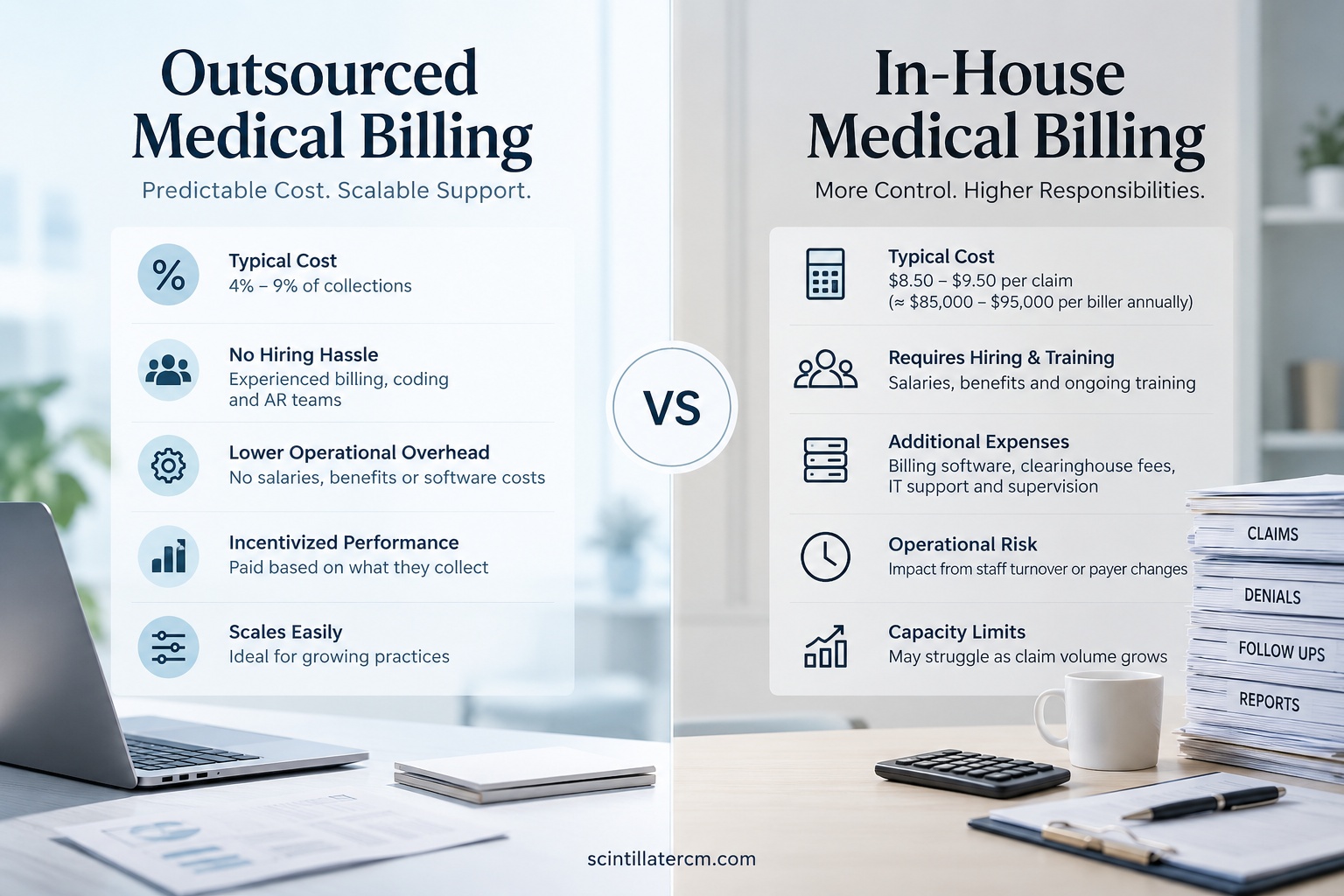
Medical billing outsourcing means handing coding, claims submission, payment posting, and denial follow-up to a third-party revenue cycle management company, instead of employing that staff directly. Most outsourced arrangements are priced as a percentage of what the company collects on your behalf, so the vendor has a direct financial incentive to get claims paid, not just submitted.
It helps to place this inside the bigger picture first. Billing is one stage within the broader medical billing RCM cycle, which starts at patient registration and eligibility verification and ends with payment posting and collections. This guide is specifically about the billing and claims segment of that cycle, coding, submission, and denial follow-up, since that’s the piece most practices actually outsource, even when they keep front-desk registration and eligibility checks in-house.
The alternative, in-house billing, means your practice employs the coders, billers, and AR staff directly, on your payroll, using software you license and manage yourself. Everything else that follows, the cost, the risk, the control you keep, comes from that basic structural difference.
Outsourcing doesn’t mean losing visibility. A properly run engagement still gives you reporting on clean claim rate, days in AR, and denial trends. What changes is who does the day-to-day work and who absorbs the cost when a biller quits or a payer changes its rules. Many practices choose to outsource medical billing services specifically once claim volume outpaces what an in-house team can handle efficiently, not because in-house billing is inherently worse.
The number practice owners usually anchor on is salary. The Bureau of Labor Statistics puts the 2024 median wage for a medical records specialist, the government’s closest job category to most billing and coding roles, at $50,250 a year. That’s not what it actually costs to employ one.
BLS’s own employer-compensation data shows benefits and payroll taxes add roughly 43% on top of wages for the average private-sector worker. Apply that to the median billing salary and the fully loaded cost, before software, clearinghouse fees, training, or supervision, is closer to $72,000. Add those in, and a realistic fully loaded cost for one in-house biller commonly lands in the $85,000 to $95,000 range.
Framed differently, as a share of revenue instead of a salary, MGMA data cited in a Physicians Practice staffing analysis puts the median cost of patient accounting, billing, and managed-care administration staff at 2.7% of net medical revenue for multispecialty practices. That’s lower than a lot of headline in-house-versus-outsourced comparisons claim, mostly because it’s base staff cost only, before software, turnover, and denial rework are layered on top.
Then there’s denial rework, which in-house teams absorb entirely on top of everything above. Premier Inc. research, cited by HFMA in August 2024, puts the average administrative cost to rework a denied claim at $47.77 for Medicare Advantage claims and $63.76 for commercial claims. A practice running 200 denials a month is looking at roughly $9,600 to $12,800 a month in rework labor alone, on top of the base billing cost. This is exactly why denial management in medical billing tends to work best as its own specialized function, rather than something a general biller handles between other tasks.
Outsourced billing is priced almost entirely on a percentage-of-collections model, though some companies offer per-claim pricing instead. Outsourced billing companies publicly quote medical billing services cost structures of roughly 4% to 9% of collections, with solo and sub-$1M practices usually paying toward the higher end (6% to 9%) and larger groups negotiating lower rates (4% to 5.5%) because their volume gives them more leverage. That range comes from vendors’ own published pricing, worth knowing since it’s not an independently audited industry average.
The percentage matters less than what’s bundled into it. A well-structured outsourced arrangement folds software, clearinghouse fees, denial follow-up, and staff turnover risk into that single number. Your outsourced partner absorbs the cost of a biller quitting and the retraining and coverage gap that follows. You just keep seeing the same percentage on your statement.
That’s the real comparison: a variable cost that scales with what you collect, against a fixed cost that scales with headcount whether collections are up or down that month.
Part of why outsourced pricing can undercut the in-house math above comes down to technology, not just headcount. RPA solutions for medical billing revenue cycle tasks, eligibility checks, claim status queries, payment posting, are increasingly used by outsourced RCM providers to handle repetitive steps at a fraction of the labor cost of a person doing them manually. A single practice building an in-house team rarely has the claim volume to justify that kind of automation investment on its own, which is part of why the percentage-of-collections model can still work out even after the vendor’s margin.
| Cost Factor | In-House Billing | Outsourced Billing |
|---|---|---|
|
Base pay |
$50,250 median wage (BLS, 2024), before benefits |
4%–9% of collections, varies by practice size |
|
Fully loaded cost |
$85,000–$95,000/year per biller once benefits, software, training, and turnover are counted |
Bundled into the percentage fee |
|
Cost per claim at full utilization |
~$8.50–$9.50/claim at ~10,000 claims per biller per year |
Your fee % × your average reimbursement per claim |
|
Denial rework labor |
Absorbed internally; $47.77–$63.76 per reworked claim (Premier/HFMA, 2024) |
Typically included |
|
Staff turnover risk |
Yours to absorb |
Absorbed by the billing company |
|
Cost scales with |
Headcount, fixed regardless of volume swings |
Collections, moves with revenue |
Most in-house-versus-outsourced comparisons reduce this to a single claims-per-year threshold. That’s an oversimplification. What actually decides it is your cost per claim on each side, and that depends on your average reimbursement per claim as much as it depends on volume.
Here’s the actual math. In-house cost per claim is roughly your fully loaded biller cost divided by the claims that biller handles (a widely used staffing rule of thumb, cited in a Physicians Practice staffing analysis, is about 10,000 claims per biller per year at full capacity). Outsourced cost per claim is roughly your outsourcing fee percentage multiplied by your average collected amount per claim.
Plugging in the numbers from the table above: a fully loaded biller costing $85,000 to $95,000 a year, handling 10,000 claims, runs about $8.50 to $9.50 per claim. At a typical 6% outsourcing rate, that breaks even around $140 to $160 in average collected revenue per claim. Above that average reimbursement, in-house tends to be cheaper once a team is fully staffed and utilized. Below it, outsourcing usually wins regardless of volume.
Volume still matters, just not the way most comparisons frame it. Below roughly 10,000 claims a year, you can’t fully utilize even one biller, so you’re paying a full salary for partial output, which pushes your real cost per claim above the numbers here and tips the math further toward outsourcing. Above that volume, the average-reimbursement comparison is what actually decides it, along with staff turnover and denial-handling capacity, which don’t show up in a per-claim number at all.
Here’s how this plays out with real numbers, for a hypothetical practice built to be typical of a small primary care group, not an actual client of ours or anyone else’s.
A 3-provider primary care practice submits about 15,000 claims a year and collects $2.2 million in net revenue, which works out to roughly $147 per claim on average, a realistic figure for primary care.
At 15,000 claims a year, one biller alone is stretched well past the 10,000-claim productivity benchmark, so a realistic in-house setup needs two billers. At $85,000 to $95,000 fully loaded each, that’s $170,000 to $190,000 a year in base billing cost. Add denial rework: at an 8% denial rate, the low end of HFMA’s industry range, that’s 1,200 denied claims a year, costing roughly $57,000 to $77,000 in rework labor at the Premier/HFMA rates above. Total in-house cost: roughly $227,000 to $267,000 a year.
Outsourced, at the 6% to 9% rate typical for a sub-$3M practice, this practice would pay roughly $132,000 to $198,000 a year, with denial rework typically bundled in.
That’s a gap of roughly $29,000 to $135,000 a year in favor of outsourcing for this specific practice, driven less by claim volume alone and more by its $147 average reimbursement sitting below the $140–$160 breakeven range, combined with needing two billers instead of one fully utilized one. A higher-reimbursement specialty at the same claim volume could land on the other side of that math entirely.
Your own numbers, average reimbursement, denial rate, and staffing needs, will differ from this example. Running your actual claim volume and collections through the formula above, or through a free billing or denial audit, will tell you which side of the breakeven your practice actually falls on.
Claim volume alone doesn’t settle every case. Use this to place your own practice against the factors that actually move the decision.
| Factor | Favors Outsourcing | Favors In-House |
|---|---|---|
|
Average reimbursement per claim |
Below roughly $140–$160/claim |
Above roughly $140–$160/claim |
|
Annual claim volume |
Under ~10,000/year (can’t fully utilize one biller) |
Comfortably above 10,000/year per biller, stable team |
|
Billing staff turnover |
High or unpredictable |
Low, long-tenured team |
|
Growth stage |
Scaling fast, volume unpredictable |
Stable, mature claim volume |
|
Tech/software budget |
Limited capital for a billing stack |
Can invest in EHR-integrated tools |
|
Specialty complexity |
Standard, common specialty |
Deep niche-specialty coding needs |
|
Payer mix |
Broad, multi-payer, multi-state |
Narrow, small number of payers |
|
Current denial backlog |
Already unmanaged or growing |
Actively managed, low denial rate |
If most of your answers land in one column, that’s your direction. A mixed result usually means you’re near the breakeven point, and a free billing or denial audit is the fastest way to get a real answer instead of guessing.
The benefits of outsourcing medical billing show up most clearly in a few recurring situations, not universally, and they’re worth naming directly rather than treating outsourcing as a default answer.
Outsourcing is usually the right call if your average reimbursement per claim runs below roughly $140 to $160, or if your claim volume sits under about 10,000 a year, since that’s not enough to fully utilize even one dedicated biller. It’s also usually right if your billing staff turnover is unpredictable, since every departure resets training cost and reopens your denial backlog while a replacement ramps up.
Growing or scaling practices are strong outsourcing candidates too. A practice adding providers or opening a second location has volume that’s changing month to month, and a percentage-of-collections fee scales with that automatically, where an in-house team either sits underutilized or gets overwhelmed depending on which direction volume moves.
The same goes for practices juggling a broad, multi-payer mix, since a denial management services team working claims across many practices sees payer-specific denial patterns faster than an in-house team mostly dealing with the same handful of payers, and it’s part of how we approach this differently than a generalist outsourced medical billing company would.
Medicaid medical billing is worth calling out on its own. Medicaid claims typically reimburse well below commercial rates and carry more state-specific rules, timely filing limits, prior authorization requirements, coverage differences that shift by state, than a standard commercial claim. A practice with a heavy Medicaid patient mix is more likely to sit below the $140 to $160 per-claim breakeven purely because of that reimbursement gap, regardless of how efficient the billing team is, which is exactly the kind of situation where outsourcing to a team that already handles multi-state Medicaid rules tends to pay for itself.
In-house billing tends to win for practices with a higher average reimbursement per claim, above roughly $140 to $160, and volume comfortably above 10,000 claims a year per biller, run by a stable, low-turnover team, especially where that team has deep expertise in a niche specialty’s coding quirks that a generalist billing company would need time to learn.
It also makes sense where a practice needs direct, real-time control over how aggressively a claim gets worked, useful for unusual documentation workflows or a payer mix a standard outsourced process isn’t built around, or where clinical and billing staff need to coordinate closely on complex cases.
The tradeoff doesn’t disappear just because volume favors in-house. You’re still carrying every cost in the table above yourself, with no one else absorbing the risk when a biller leaves or a payer changes its rules. High volume makes in-house viable. It doesn’t make it free of risk.
Four questions settle this more reliably than any percentage in this guide:
If you can’t answer all four with real numbers, that’s worth fixing before the in-house-versus-outsourced decision gets made on anything other than a guess. The decision matrix above is built to get you those numbers directly.
There’s no universal right answer to which is more cost-effective, in-house or outsourced medical billing. There’s a claim volume, an average reimbursement per claim, a turnover rate, and a fully loaded cost your practice hasn’t calculated yet, and the decision matrix and worked example above exist to help you find those numbers instead of guessing.
Request a free billing or denial audit, and Scintillate RCM Healthcare will show you exactly what your current setup is costing you and whether outsourcing would save real money at your specific volume and reimbursement mix, not a generic industry percentage.
Medical billing outsourcing is hiring a third-party revenue cycle management company to handle coding, claims submission, payment posting, and denial follow-up instead of doing it with in-house staff. Most arrangements are priced as a percentage of collections, so the vendor is incentivized to get claims paid, not just submitted.
It depends on your average reimbursement per claim and volume more than on practice size. Outsourced billing typically runs 4% to 9% of collections. In-house billing, fully loaded with wages, benefits, software, and denial rework, typically costs $8.50 to $9.50 per claim once a biller is fully utilized, which tends to be cheaper only above roughly $140 to $160 in average reimbursement per claim.
It depends on both claim volume and average reimbursement per claim, not a single threshold. Using a typical fully loaded in-house cost of $8.50 to $9.50 per claim at full staff utilization and a typical 6% outsourcing rate, the crossover falls around $140 to $160 in average reimbursement per claim, assuming enough volume, roughly 10,000 or more claims per biller per year, to fully utilize billing staff.
Outsourced medical billing is typically priced as a percentage of collections, usually 4% to 9%, with smaller practices paying toward the higher end and larger practices negotiating lower rates due to volume. Some companies offer per-claim pricing instead.
Yes, but the math usually only favors it above roughly 10,000 claims a year per biller and an average reimbursement above roughly $140 to $160 per claim. Small practices below either threshold often end up paying more per claim in-house than they would outsourcing, once every hidden cost, benefits, software, training, denial rework, staff turnover, is actually counted.
Free RCM Health Check. Receive a custom benchmark report comparing your performance against industry standards in 2 days.

Scintillate Healthcare LLC, Georgetown, Texas.
Cash Accelerated Care Elevated